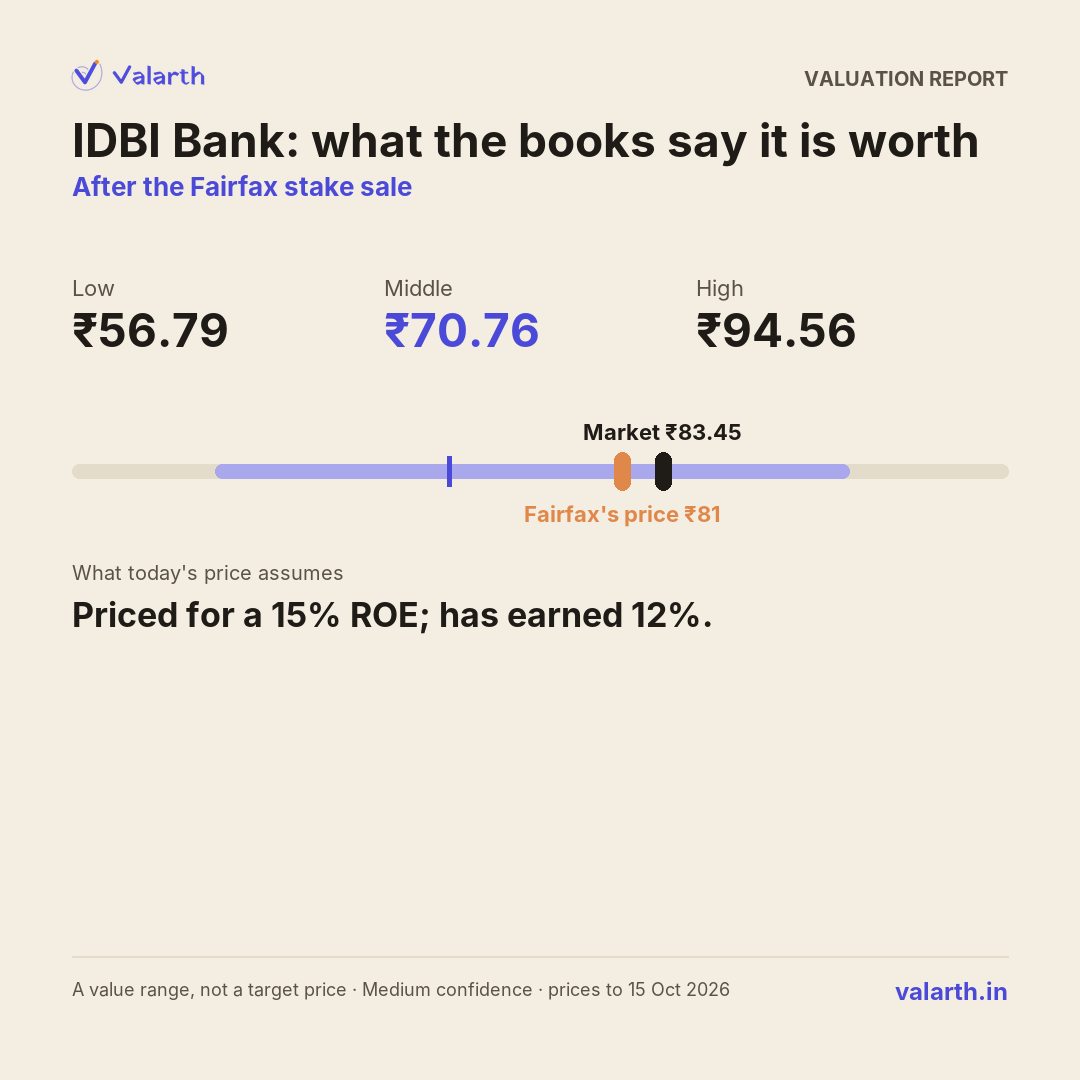
IDBI Bank valuation after the Fairfax deal: a value range from its own books, next to the ₹81 a share
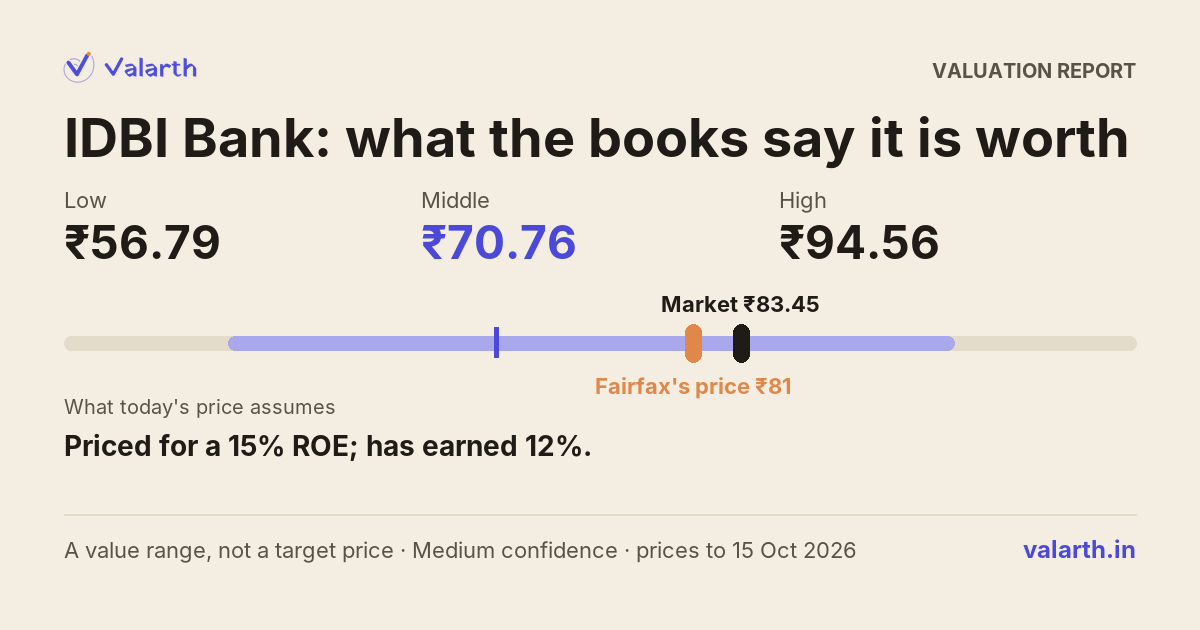
Valarth's valuation engine puts IDBI Bank at ₹56.79 to ₹94.56 a share, ₹70.76 in the middle, with medium confidence. The ₹81 a share in the stake sale sits inside the range, above its middle; the market price of ₹83.45 on 15 Oct 2026 sits inside the range, above its middle.
Low₹56.79
Middle₹70.76
High₹94.56
₹83.45Market, 15 Oct 2026
₹81Fairfax's price
Published 16 Oct 2026 · Bank, mature growth · Medium confidence (84/100) · engine 1.0.0, prices to 15 Oct 2026 · IDBI Bank share price and figures
Share
IDBI Bank valuation at a glance
Value range
₹56.79 to ₹94.56
Middle of the range
₹70.76
Fairfax's price
₹81
Market price
₹83.45 on 15 Oct 2026
Book value a share
₹63.93
Price to book
1.31×
Return on equity, 12 months
13.5%
Confidence
Medium (84/100)
What happened: the IDBI Bank stake sale
On 14 October 2026 the Cabinet Committee on Economic Affairs approved the sale of 60.72% of IDBI Bank to a Fairfax Financial Holdings company, 10955230 Canada Inc.
The road to the sale
Oct 2022Bids invited
The government and LIC invite bids for 60.72% of the bank, with management control.
Jul 2026A higher offer reported
The exchange asks IDBI Bank about reports that the government is close to accepting a sweetened Fairfax offer.
14 Oct 2026Sale approved
The cabinet committee approves the sale to a Fairfax company for ₹52,878 crore, about ₹81 a share.
NextRBI approval
The RBI's fit-and-proper check of the buyer, then the share purchase agreement.
ThenOpen offer
An offer to public shareholders under SEBI's takeover rules; price and size not yet set.
Who owns the bank
Before the sale
45%49%
After the sale
61%19%15%
FairfaxLICGovernmentPublic
After the sale LIC has two years to come down to 15%; Fairfax has a five-year lock-in, then 15 years to reach the RBI's 26% limit for a promoter.
The sellers are the Government of India (30.48%) and LIC (30.24%). The price is ₹52,878 crore, about ₹81 a share; two independent valuers had put fair value at ₹75.99 a share.
Every method's answer on one line, with the market price and Fairfax's price across them. Methods partly disagree (CV 16%); range widened to cover the method spread and confidence lowered one level.
Residual income60% of the blend
Dividend discount model15% of the blend
Peer P/B12% of the blend
Justified P/B12% of the blend
Valarth rangethe blend
Market ₹83.45
Fairfax's price ₹81
₹50₹60₹70₹80₹90₹100₹110
Method
Weight
Low
Value
High
Residual income
60%
₹52.80
₹70.66
₹106
Dividend discount model
15%
—
₹68.08
—
Peer P/B
Peer median P/B applied to book value.
12%
₹69.82
₹88.41
₹109
Justified P/B
12%
—
₹56.79
—
What today's price assumes about IDBI Bank
Priced for a 15% ROE; has earned 12%.
Today's price assumes a steady 14.8% return on equity for 10 years; the company has earned 12.3% on average over the last 3 years. How a reverse valuation works →
Earned, last 12 months · 13.5%
Earned, 3-year average · 12.3%
Cost of equity · 13.2%
How we valued IDBI Bank
A bank's assets and debts are its raw material, so it is valued on its book and on what it earns on that book, not on cash flow.
Book value a share₹63.93
Earnings a share (12 months)₹8.64
Cost of equity13.2%6.5% risk-free + β 1.22 × 5.5%
Long-run growth5.5%
IDBI Bank: bear, base and bull cases
The range is the spread of these cases, each run through the same residual-income model.
ControlThe ₹81 buys 60.72% and the right to run the bank; the range values an ordinary share in the business as it earns today. The two answer different questions.
2
The open offerIts price and size are not yet set, so nothing about it is in the range.
3
The recent rise in returnsThe base case starts from the three-year average return on equity (12.3%); the last twelve months earned 13.5% on year-end book. If that level holds, the value is higher, which is the direction the bull case shows.
4
The pastIDBI lost money in four of the last ten years. The model reads that as no moat: its base case has returns rising only to the cost of equity, never above it.
<a href="https://app.valarth.in/valuations/idbi-bank"><img src="https://app.valarth.in/valuations/idbi-bank/card.png" alt="IDBI Bank valuation: the value range next to the market and deal prices, by Valarth" width="600" height="315" loading="lazy"></a>
A link posted on X, Reddit, LinkedIn or WhatsApp shows this picture as its preview. The embedded picture always shows the latest run.
IDBI Bank valuation: questions answered
What is IDBI Bank's value range?
₹56.79 to ₹94.56 a share from Valarth's engine, run on prices to 15 Oct 2026, with medium confidence. It is a range, not a target price.
How does Valarth value a bank like IDBI Bank?
Mostly by residual income: book value plus the profit earned above the cost of equity in the years ahead. A dividend model, the price-to-book of peer banks and a justified price-to-book check it.
What is IDBI Bank's book value per share?
₹63.93 a share on the latest accounts; at ₹83.45 the stock trades at 1.31 times book.
What return on equity does IDBI Bank earn?
13.5% over the last twelve months on year-end book, and 12.3% on average over three years, against a cost of equity of 13.2% in the model.
What price is Fairfax paying for IDBI Bank?
₹52,878 crore for 60.72%, about ₹81 a share, approved by the Cabinet Committee on Economic Affairs on 14 October 2026. Two independent valuers had put fair value at ₹75.99 a share.
Who will own IDBI Bank after the sale?
A Fairfax Financial Holdings company with 60.72%, LIC with about 19% and the government with about 15%, plus public shareholders. An open offer to public shareholders follows the share purchase agreement.
When will the IDBI Bank stake sale complete?
The government expects it within 2026-27. The RBI must first clear Fairfax as fit and proper; then come the share purchase agreement and the open offer to public shareholders.
Learn to value companies correctly at Valarth
Every number on this page has a lesson behind it: what it is, a worked example in rupees, and the mistakes people make with it. Free to read.
Educational research built from public filings and a published method. A value range, not a target price and not a recommendation to buy, sell or hold. Valarth is not a SEBI-registered research analyst or investment adviser.