VALARTH See Canara Bank in the appOpen in app
CANBK · NSE · Public Sector Bank

Canara Bank

What the numbers mean, from its filings and the exchange. Data as of 12 Oct 2026.
Large Cap · AMFI list Jan-Jun 2026 · Vendor sector: Financial Services
fair low confidence No valuation within 120 days; P/E 5.5 vs peers 6.7 (2nd of 10); P/B 0.99 vs peers 0.94 (6th of 10).
Statements through FY2026Prices adjusted for corporate actionsNot yet reviewed by the adversarial model

What is Canara Bank's share price today?

Canara Bank last traded at ₹118.38 on the NSE, as of 12 Oct 2026, 11:00 pm IST, down 1.0% on the day, down 6.3% over a year. Its 52-week range is ₹117 to ₹163. The live price is in the app.

₹118.38 −1.0% today
−6.3% over 1 year · NSE, as of 12 Oct 2026, 11:00 pm IST
60 month-end closes, 31 Oct 2021 to 30 Sep 2026, adjusted for splits and bonuses
52-week range4% of the way up
Low ₹117High ₹163

What is Canara Bank's market cap?

Canara Bank's market capitalisation is about ₹1.08 lakh crore: what it would cost to buy every share at today's price. That makes it the 89th largest large cap company we cover.

₹1.1 L Cr Large Cap89th largest large cap company
Large Cap means the 100 largest listed companies, under SEBI's rules. Shares in issue are worked out from the market cap and the price. What market cap tells you →

Key facts

From the exchange
Symbol
NSE: CANBK
ISIN
INE476A01022
Cap bucket
Large Cap, 89th largest by market cap
Industry (NSE)
Financial Services › Banks › Public Sector Bank
Listed since
2002
Futures and options
Traded

Is Canara Bank overvalued?

Fair, with low confidence: no valuation within 120 days; P/E 5.5 vs peers 6.7 (2nd of 10); P/B 0.99 vs peers 0.94 (6th of 10).

Valuation

Latest price and trailing 12 months
P/E 5.46
vs peers 6.7 · 2nd of 10
Price divided by last year's earnings per share: how many years of today's profit you pay for. Learn more →
P/B 0.99
vs peers 0.9 · 6th of 10
Price divided by book value per share: what you pay for each rupee of net assets on the balance sheet. Learn more →
Market cap ₹1.08 lakh Cr
Total market value of all shares, in ₹ crore. Learn more →
Dividend yield 3.4%
vs peers 3.0% · 3rd of 8
Last year's dividends as a share of today's price. Learn more →
PEG (vendor) 1.56
vs peers 2.6 · 4th of 8
P/E divided by the vendor's earnings growth figure, which it does not disclose; a P/E adjusted for how fast profits grow. Learn more →
PEG on our 3-year EPS growth 0.33
P/E divided by the 3-year EPS growth rate from the stored accounts. Learn more →
3 models could be judged
Skipped — Fair value, EPV, Graham number, Graham value, Lynch, Owner earnings: no valuation stored

Our valuation range

🔒 Pro
Value range, implied growth at today's price, and the nine models behind it: in the app.

Is Canara Bank a quality business?

Quality score 44.4, 6th of 10 in its peer set; CLEAN on 21 of 22 lender flags judged.

Quality and risk

Data as of 12 Oct 2026
Business quality Not available
The kind of business, which sets the yardstick it is judged by. Learn more →
Quality score 44.4
vs peers 48.1 · 6th of 10
Returns, margins, leverage and consistency against its peers, out of 100. Learn more →
Risk level CLEAN
21 of 22 lender flags judged
From flags on debt, earnings quality, dilution and price swings. Learn more →

Lender scorecard

Statements through FY2026 (Mar-26)
Basis: standalone accounts, FY2026 (Mar-26) against FY2025; NSE/BSE XBRL, the Q4 results filing; NIM is interest earned less expended over average advances and investments; cost to income is operating expenses over net interest income plus other income; credit cost is FY2026 provisions over average advances; ROA over average total assets; ROE over average equity; GNPA, NNPA, provision coverage, CET1 from the Jun-26 quarter filing
Net interest margin 2.4%
vs peers 3.1% · 10th of 10
What a lender earns on its loans and investments less what it pays for deposits and borrowings, as a share of the assets that earn interest (or of all assets where the split is not filed). Learn more →
Gross NPA 1.6%
vs peers 2.0% · 3rd of 10
Loans on which repayment has stopped, as a share of all loans, before any provision against them; from the latest results filing. Learn more →
Net NPA 0.4%
vs peers 0.3% · 6th of 10
Bad loans after the provisions already set aside against them, as a share of loans. Learn more →
Provision coverage 77.1%
How much of the gross bad loans has already been provided for. Learn more →
Credit cost 0.7%
vs peers 0.6% · 7th of 10
The year's provisions for bad loans as a share of the average loan book. Learn more →
Cost to income 48.5%
vs peers 49.1% · 4th of 10
Operating expenses (staff, branches, technology) over net interest income plus other income. Learn more →
Return on assets 1.1%
vs peers 1.1% · 5th of 10
Profit as a share of average total assets. Learn more →
CET1 ratio 17.2%
Common equity tier 1 capital, the hardest kind, against risk-weighted assets; from the latest results filing. Learn more →
Loan growth YoY 16.3%
vs peers 17.0% · 7th of 10
Growth in the loan book over the latest fiscal year. Learn more →
Deposit growth YoY 7.7%
vs peers 12.3% · 9th of 10
Growth in deposits over the latest fiscal year. Learn more →
CASA ratio Not available
Current and savings account balances as a share of all deposits. Learn more →
Inside the app

Get a sneak peek of Valarth

Start freeStart free
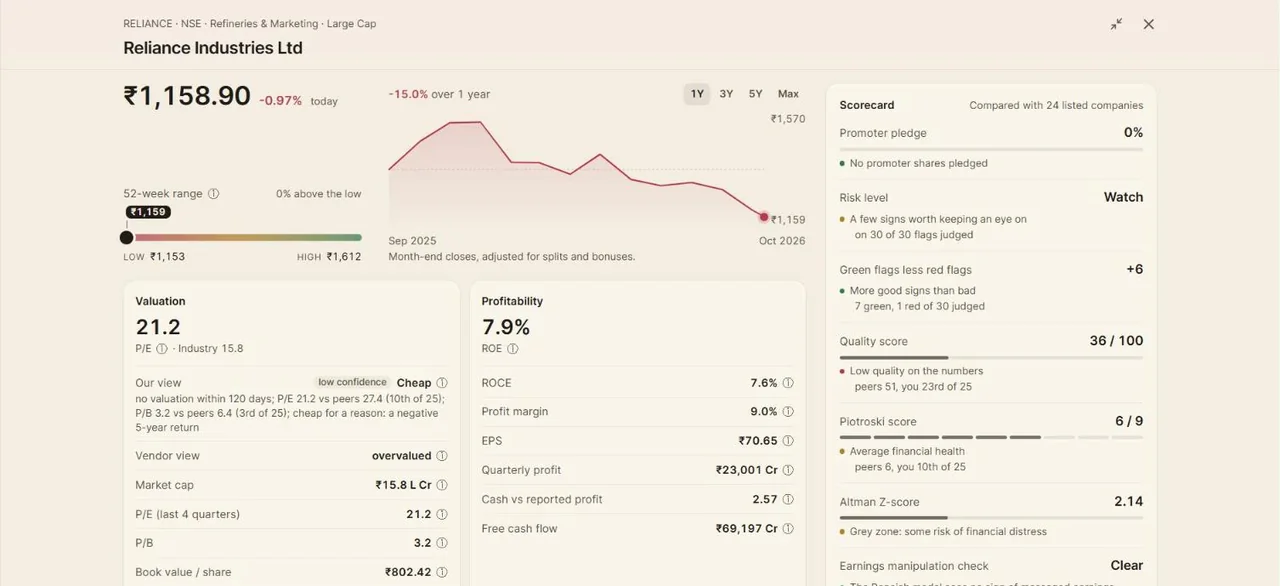
A Valarth stock page: the share price with its chart and 52-week range, valuation and profitability figures, and a scorecard of health checks.
Stock pagePrice, valuation, profitability and a scorecard of health checks for every company, each figure explained.
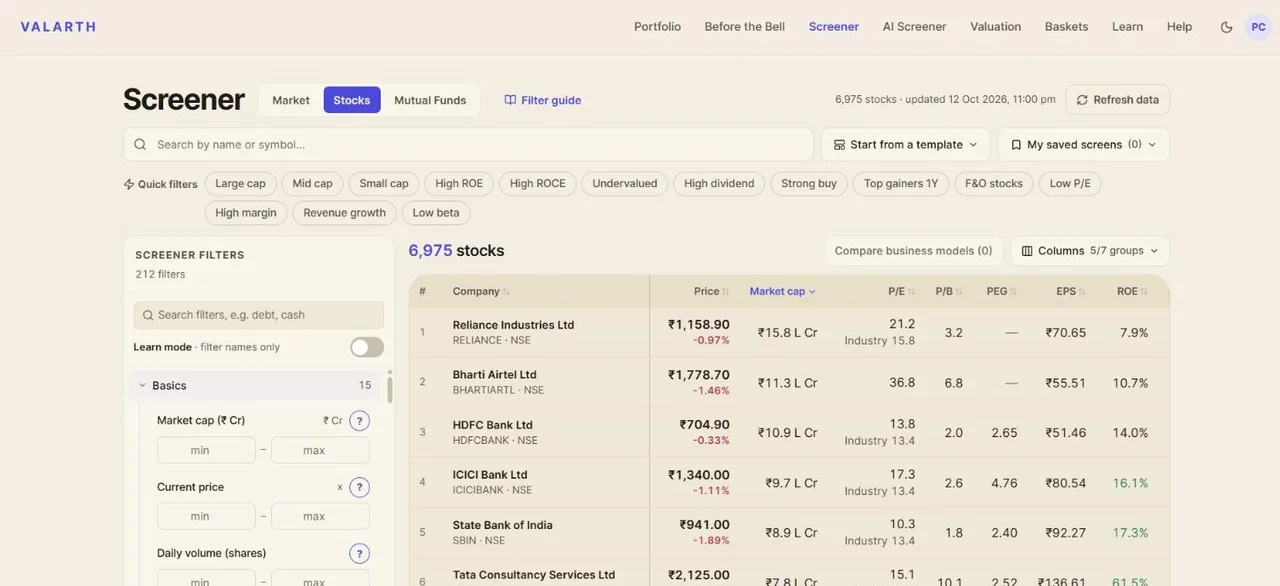
The Valarth stock screener: a table of companies with price, market cap, P/E, P/B, PEG, EPS and ROE, and filters down the left.
ScreenerEvery listed company, filtered on 212 figures, each with a plain-language lesson beside it.
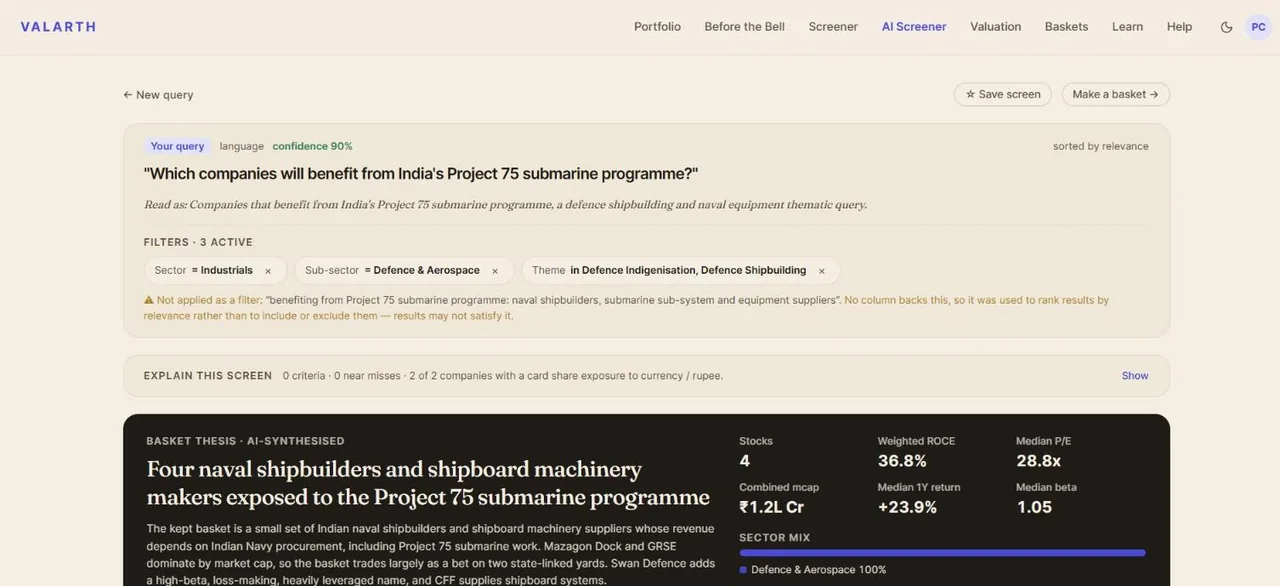
The Valarth AI Screener answering 'Which companies will benefit from India's Project 75 submarine programme?' with a basket of four naval shipbuilders and a written thesis.
AI ScreenerAsk a question in plain English, like which companies benefit from India's Project 75. It reads the intent, builds the screen and writes the thesis.
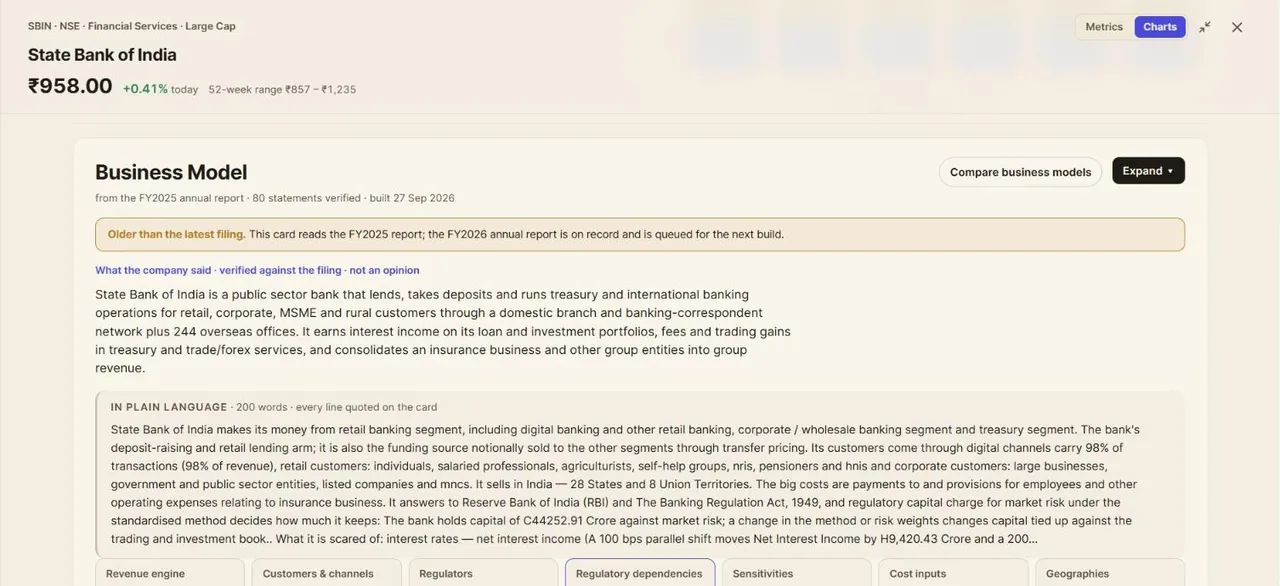
A Valarth business-model card for State Bank of India, with a plain-language summary and statements verified against the filing.
Business modelHow a company makes money and what can hurt it, each statement checked against its annual report.
Valarth's Before the Bell edition, with the day's headline, regulator notes and sector moves.
Before the BellA morning edition before the market opens: what moved, which rule changed, and what it means for your holdings.

Has Canara Bank made money for shareholders?

Mixed: −6.3% over one year and +28.1% a year over five years.

Shareholder returns

1-year return −6.3%
Price only
What the share price did over the last 12 months. Learn more →
5-year return +28.1% a year
Price only
Yearly average price return over five years, bonuses and splits adjusted. Learn more →
Wealth destroyer No
Five-year total return — price CAGR on bonus- and split-adjusted closes plus the dividend yield — below the 7% a bank fixed deposit paid. Learn more →

Returns

3Y and 5Y are yearly averages
1W
+0.9%
1M
−2.3%
3M
−7.5%
6M
−13.8%
1Y
−6.3%
3Y
+15.8%
5Y
+28.1%

Does Canara Bank pay a dividend?

Yes. Canara Bank's dividend yield is 3.40% at the latest price; the last payout was ₹4.20 a share, ex-dividend 12 Jun 2026.

Dividends

Per share, by ex-dividend date
Dividend yield3.40%
The past 12 months' dividends as a share of today's price.
12 Jun 2026 · Final₹4.20
13 Jun 2025 · Final₹4.00
14 Jun 2024 · Final₹3.22
14 Jun 2023 · Final₹2.40
15 Jun 2022 · Final₹1.30
Payout ratio🔒 In the app
The share of profit paid out as dividends; a very high share leaves little to reinvest.
Dividend growth, 5 years🔒 In the app
How fast the dividend per share has grown a year.
Years without a miss🔒 In the app
How many years in a row a dividend has been paid.

Is Canara Bank growing?

Loan growth 16.3%; deposit growth 7.7%; revenue 3 years 11.2% a year.

Growth

Statements through FY2026 (Mar-26)
Loan growth 16.3%
vs peers 17.0% · 7th of 10
Growth in the loan book over the latest fiscal year. Learn more →
Deposit growth 7.7%
vs peers 12.3% · 9th of 10
Growth in deposits over the latest fiscal year. Learn more →
Revenue 3 years 11.2% a year
vs peers 14.1% · 9th of 10
Compound annual growth of revenue over three years. Learn more →
EPS 3 years 16.7% a year
Growth in earnings per share, so dilution counts against the company. Learn more →
Revenue 5 years 9.9% a year
Compound annual growth of revenue over five years. Learn more →
EPS 5 years 35.5% a year
Growth in earnings per share over five years, so dilution counts against the company. Learn more →

How did Canara Bank do last quarter?

Canara Bank reported income of ₹39,696 Cr, up 0.3% on a year earlier and a net profit of ₹5,181 Cr, up 1.9% in the Jun 2026 quarter.

Latest quarter

Jun 2026
Income, latest quarter₹39,696 Cr
+0.3% on a year earlier
What the company took in over the quarter.
Net profit, latest quarter₹5,181 Cr
+1.9% on a year earlier
What was left for shareholders after every cost and tax.

How does Canara Bank compare with its peers?

Compared with 9 Public Sector Bank; 2nd of 10 on P/E; 6th of 10 on quality score.

Canara Bank against its peers

Largest 9 of 9 peers, by market cap
CompanyMarket capP/EP/BROE1YQuality 🔒Rank 🔒
Canara Bank₹1.1 L Cr5.51.018.0%−6.3%
Punjab National Bank₹1.3 L Cr6.10.913.4%+0.0%
Union Bank of India₹1.3 L Cr6.41.016.3%+23.7%
Bank of Baroda₹1.2 L Cr6.70.813.8%−12.1%
Indian Bank₹1.1 L Cr8.71.618.2%+5.9%
Bank of Maharashtra₹63,963 Cr8.51.524.2%+44.4%
Bank of India₹61,215 Cr5.20.814.0%+6.0%
Indian Overseas Bank₹58,887 Cr10.01.812.3%−23.2%
UCO Bank₹29,154 Cr10.40.99.5%−26.9%
Central Bank of India₹27,245 Cr6.00.813.0%−20.4%
Peer median—6.70.913.8%+0.0%
Market cap in rupees crore; P/E and P/B on the latest price; 1Y is the price return over a year. A dash is a figure that does not apply or is not reported.

Full peer comparison

🔒 Pro
Every peer, every figure, the ranks and the quality and forensic scores side by side: in the app.

Who owns Canara Bank?

Canara Bank is held by promoters 62.9%, foreign institutions 12.3%, domestic institutions 12.4%.

Shareholding pattern

Latest filing, percent of shares
Promoters62.9%
The founders and controlling group.
Foreign institutions12.3%
Overseas funds investing through the FPI route.
Domestic institutions12.4%
Indian insurers, banks, pension and mutual funds together.
Mutual funds7.0%
Indian mutual fund schemes; part of domestic institutions.
Retail and others7.3%
Individual investors and everyone else.
Promoter shares pledged🔒 In the app
Promoter shares given as collateral for loans; a high share is a risk to watch.
Holding trend🔒 In the app
Whether promoters, foreign funds and mutual funds have been adding or selling over recent quarters.

What do analysts say about Canara Bank?

20 analysts cover Canara Bank, and the consensus is buy. A consensus is a count of opinions, not a forecast; read it beside the numbers.

Analyst consensus

20 analysts
ConsensusBuy
The rating most covering analysts give the share.
Average target price🔒 In the app
The mean of the analysts' 12-month price targets.
Upside to target🔒 In the app
How far the target sits above or below today's price.
Share rating it a buy🔒 In the app
The share of covering analysts with a buy rating.

What does Canara Bank do and what is it sensitive to?

Canara Bank is a nationalized bank providing retail, wholesale banking and treasury services to individuals, SMEs, corporations and non-residents across India; it earns through deposits, lending, investments, forex services and subsidiary life insurance operations. Sensitive to: interest rate movements.

Business-model card

FY2025 · 46 verified
4Revenue
5Channels
3Regulators
5Reg. dependencies
6Sensitivities
3Costs
2Geographies

Canara Bank is a nationalized bank providing retail, wholesale banking and treasury services to individuals, SMEs, corporations and non-residents across India; it earns through deposits, lending, investments, forex services and subsidiary life insurance operations.

Revenue by segment

Year ended 31 March 2025 (Consolidated)
Treasury Operations18.1%
Retail Banking Operations - Digital Banking0.0%
Retail Banking Operations - Other Retail Banking42.6%
Wholesale Banking Operations32.1%
Life Insurance Operation7.2%

Revenue engine

4 verified
Retail Banking (45.9%)
Personal deposit accounts (savings, current, term), loans (home, education, personal), investment products, digital services (FASTag, UPI), NRI banking
Wholesale/Corporate Banking (34.6%)
Treasury services, forex, investment banking, risk management and API-based digital solutions for corporates and multinationals
Treasury Operations (19.5%)
Investment portfolio management, interest rate hedging via derivatives, market-making and proprietary trading
1 more statement
Subsidiary Life Insurance Operations
Linked and non-linked life insurance products sold via bank branches and agents; premium income from unit-linked, variable and regular premium policies

Customers & channels

5 verified
Retail customers: individuals and salaried staff
Deposits, loans for home-buying, education and personal expenses, investment products via branches and digital channels
SME and business customers
Credit lines, payroll management and supply chain finance to support business growth and operations
Priority lending segments: farmers, vulnerable communities, minorities
Aligned with national priorities for agriculture, education, housing, social infrastructure, renewable energy and microcredit
2 more statements
Non-resident Indians (NRIs)
Specialized NRI banking services for overseas Indians with seamless financial management
Digital banking channels
DBUs/CANDI branches for paperless banking; 24/7 call centre in 17 languages; social media platforms; online and mobile banking

Regulators

3 verified
Reserve Bank of India (RBI)
Supervises banking operations, credit risk, market risk, liquidity, capital adequacy, lending policies and issues directions on compliance
Securities and Exchange Board of India (SEBI)
Governs listing obligations, disclosure requirements, insider trading, and corporate governance of the bank as a listed entity
Insurance Regulatory and Development Authority of India (IRDAI)
Regulates subsidiary life insurance operations, policy valuation, premium recognition and product design

Regulatory dependencies

5 verified
Credit Risk Management and internal credit rating policies
RBI-mandated policies govern loan approvals, pricing and monitoring; stricter policies or rating changes affect lending capacity and profitability
Market Risk and Derivative hedging limits
RBI-approved limits on interest rate swaps, forwards and other derivatives; tighter limits reduce hedging options and increase interest rate exposure on portfolio
Liquidity Coverage Ratio (LCR) and Net Stable Funding Ratio (NSFR)
Basel-defined stress ratios that must be maintained; capital requirement changes affect funding cost and lending margins
2 more statements
Unified Lending Interface (ULI) for MSME and agri lending
RBI Innovation Hub integration for digital lending; compliance requirements and eligibility criteria affect loan approval speed and product design
Financial Inclusion and Priority Sector Lending targets
RBI mandates minimum lending to agriculture, SME, housing and other priority sectors; failure to meet targets incurs penalties

Sensitivities

6 verified
Interest rate movements
Higher rates increase deposit costs and reduce loan demand; lower rates compress net interest margins on investment portfolio and reduce revenue from treasury operations
Monsoon and agricultural output
Good monsoon increases farm incomes and reduces food inflation, boosting rural demand for loans and deposits; poor monsoon reduces agricultural credit demand
India's domestic economic growth
Faster growth in manufacturing, services and private consumption drives loan demand and asset quality; slowdown reduces creditworthiness of borrowers
3 more statements
Global economic slowdown and trade tensions
Weaker global demand reduces export-focused corporate lending; trade wars reduce FX revenues and corporate profitability affecting repayment capacity
Foreign exchange (FX) rate volatility
Depreciation of rupee increases cost of external borrowing and affects NRI remittances; appreciation reduces export competitiveness
Inflation and purchasing power
Higher inflation reduces real incomes and demand for loans; controlled inflation (below 4% target) supports consumption and credit growth

Cost inputs

3 verified
MSME and small producer sourcing (28.0%)
Direct procurement of materials and services from micro, small and medium enterprises; cost and availability driven by MSME business cycles
Employee costs and training
Salary, benefits, training programs for staff; increasing wages and talent competition drive costs upward
Technology and infrastructure investment
Core Banking Solution (CBS), digital platforms, AI/ML systems, cybersecurity; ongoing capex for digital transformation

Geographies

2 verified
Domestic India (95.5%)
Primary market covering 28 states and 8 union territories with 9,604 branches; focus on rural and semi-urban financial inclusion
International locations (4.4%)
Limited presence in 4 countries: Gift City (IFSC), London, New York and Dubai; support for NRI and trade finance
Each statement is checked word for word against the FY2025 annual report; the passages are in the app.

What changed recently?

Q1 FY2027 results filed (27 Jul 2026).

Change log

6 entries · newest first
  1. Results filedQ1 FY2027 results filed.
  2. Results filedQ4 FY2026 results filed.
  3. Results filedQ3 FY2026 results filed.
  4. Results filedQ2 FY2026 results filed.
  5. Results filedQ1 FY2026 results filed.
  6. Results filedQ4 FY2025 results filed.
Get alerts →Sign in to be told when any of these change.

What this page does not tell you

What could not be judged, and why. Never empty.
  • Models not runFair value, EPV, Graham number, Graham value, Lynch, Owner earnings: no valuation stored.
  • FlagsCLEAN on 21 of 22 lender flags judged; no red flag; 1 could not be judged.
  • Data gapsBusiness quality, CASA ratio: not available yet.
Not applicable to a bank, lender or insurer · 12
  • Altman ZAltman Z reads working capital and sales over assets, which a lender's balance sheet does not have.
  • Piotroski F-scorePiotroski's leverage and liquidity checks read deposits and borrowings as weakness.
  • Beneish M-scoreThe Beneish model reads receivables, margins and depreciation that a lender's accounts do not report.
  • Operating marginInterest is a lender's cost of goods, so operating profit before interest is not defined.
  • Interest coverageInterest is a lender's main cost, not a charge on operating profit.
  • Debt to equityBorrowings and deposits are a lender's raw material; gearing is judged by capital adequacy instead.
  • EV/EBITDAEnterprise value adds borrowings to market cap; for a lender borrowings are the business, not a claim on it.
  • FCF yieldOperating cash flow less capex is not free cash flow for a lender: loan growth sits in operating cash flow.
  • Cash conversion cycleA lender's receivables are its loan book, not invoices waiting to be paid.
  • Asset turnoverA lender earns a spread on its assets, not a turnover of them.
  • ROCEEBIT over capital employed reads a lender's interest income against its borrowings; return on assets and return on equity are the lender's measures.
  • ROCE, 10-year averageEBIT over capital employed reads a lender's interest income against its borrowings; return on assets is the lender's measure (HDFC Bank's 1.7% ten-year ROCE means nothing).

What this page rests on

✓10 years of annual statements, through FY2026 (Mar-26)✓10 quarters of results✓285 months of month-end prices, adjusted for bonuses and splits○no valuation of ours yet✓business-model card FY2025 · 46 verified

Questions people ask

What is Canara Bank's share price today?

Canara Bank last traded at ₹118.38 on the NSE, as of 12 Oct 2026, 11:00 pm IST, down 1.0% on the day, down 6.3% over a year. Its 52-week range is ₹117 to ₹163. The live price is in the app.

What is Canara Bank's market cap?

Canara Bank's market capitalisation is about ₹1.08 lakh crore: what it would cost to buy every share at today's price. That makes it the 89th largest large cap company we cover.

Is Canara Bank a large cap, mid cap or small cap?

Canara Bank (CANBK) is a large cap company in AMFI's classification for Jan-Jun 2026. SEBI's buckets go by rank on six-month average market capitalisation: the top 100 are large caps, 101 to 250 mid caps, the rest small caps.

What is Canara Bank's P/E ratio?

5.46, vs peers 6.7 · 2nd of 10. Price divided by last year's earnings per share: how many years of today's profit you pay for.

Is Canara Bank overvalued?

Fair, with low confidence: no valuation within 120 days; P/E 5.5 vs peers 6.7 (2nd of 10); P/B 0.99 vs peers 0.94 (6th of 10).

How does Canara Bank make money?

Canara Bank is a nationalized bank providing retail, wholesale banking and treasury services to individuals, SMEs, corporations and non-residents across India; it earns through deposits, lending, investments, forex services and subsidiary life insurance operations.

Why is there no Altman Z or debt to equity for Canara Bank?

Borrowing is a bank's or lender's raw material, so those ratios mislead. Net interest margin, gross NPA, return on assets and the capital ratios are shown instead.

Who are Canara Bank's peers?

Compared with 9 Public Sector Bank: Punjab National Bank, Union Bank of India, Bank of Baroda, Indian Bank, Bank of Maharashtra and 4 more. The app shows how they compare on every figure.

Is this investment advice?

No. Valarth is a research and learning tool and is not a SEBI-registered investment adviser or research analyst. The figures come from the company's filings and the exchanges; what to do with them is your call.

How did Canara Bank do last quarter?

Canara Bank reported income of ₹39,696 Cr, up 0.3% on a year earlier and a net profit of ₹5,181 Cr, up 1.9% in the Jun 2026 quarter.

Who owns Canara Bank?

Canara Bank is held by promoters 62.9%, foreign institutions 12.3%, domestic institutions 12.4%.

Does Canara Bank pay a dividend?

Yes. Canara Bank's dividend yield is 3.40% at the latest price; the last payout was ₹4.20 a share, ex-dividend 12 Jun 2026.

What do analysts say about Canara Bank?

20 analysts cover Canara Bank, and the consensus is buy. A consensus is a count of opinions, not a forecast; read it beside the numbers.

Everything on Canara Bank, and 6,621 other companies, with 212 filters and the full peer tables